
By Study Rhino
The Internet is something we use every single day—whether we’re checking our phones, watching videos, doing homework, or chatting with friends. But have you ever wondered how it all started? How did we go from giant computers in labs to streaming movies on our phones? Let’s take a fascinating journey through time to understand the history of the Internet—from its early beginnings to the powerful global network it is today.
1. Before the Internet: The Idea of Global Communication
The desire to share information quickly and across long distances has existed for centuries. Early forms of communication networks include:
- Telegraph (1830s) – The first long-distance communication system using Morse code.
- Telephone (1876) – Invented by Alexander Graham Bell, it allowed voice communication over wires.
- Radio (1890s-1900s) – Enabled wireless communication across vast areas.
These inventions laid the foundation for what would eventually become the Internet—a system to connect people and share information worldwide.
2. The Birth of the Internet: ARPANET (1960s)
The real story of the Internet starts in the 1960s during the Cold War. The United States government wanted to create a communication system that could survive a nuclear attack and continue to function even if some parts were destroyed.
To achieve this, the Advanced Research Projects Agency (ARPA), part of the U.S. Department of Defense, launched a project called ARPANET in 1969. It was the first network to use packet switching, a method of breaking data into chunks and sending it in pieces to its destination.
Key Moments:
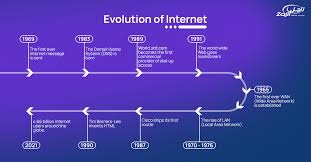
- 1969: The first successful message was sent between computers at UCLA and Stanford. The message was supposed to be “LOGIN,” but the system crashed after “LO.”
- 1971: Email was invented by Ray Tomlinson, allowing users to send messages between computers.
- 1973: ARPANET went international, connecting to networks in England and Norway.
3. Protocols: The Language of the Internet (1970s–1980s)
For computers to understand each other, they needed a common set of rules, or protocols.
The Game Changer: TCP/IP
In 1983, ARPANET officially adopted TCP/IP (Transmission Control Protocol/Internet Protocol), developed by Vint Cerf and Bob Kahn. This became the standard language for computers on the Internet and is still in use today.
TCP/IP made it easier to:
- Break data into packets
- Send it across different networks
- Reassemble it correctly at the destination
That year is often considered the official birthday of the modern Internet.
4. The Domain Name System (DNS) – 1984
Have you ever noticed websites like google.com or studyrhino.org? That’s thanks to the Domain Name System (DNS) introduced in 1984. Before DNS, users had to type in long IP addresses (like 192.168.0.1) to visit websites.
DNS made the Internet more user-friendly by letting people use easy-to-remember names instead of numbers. It’s like the Internet’s phone book!
5. The World Wide Web: A Revolution (1989–1991)
The biggest leap in Internet history came in 1989, when Tim Berners-Lee, a British computer scientist, invented the World Wide Web (WWW) while working at CERN in Switzerland.
What Did He Create?
- HTML (HyperText Markup Language): The language for building web pages.
- HTTP (HyperText Transfer Protocol): The protocol for linking web pages.
- URL (Uniform Resource Locator): The address of web pages.
By 1991, the first website was launched. The Web made it possible to:
- Display text and images on pages
- Click on hyperlinks
- Navigate between sites easily
Suddenly, the Internet wasn’t just for scientists—it became something everyone could use.
6. The 1990s: The Internet Goes Public
Until the early 1990s, the Internet was mainly used by researchers and universities. But by 1993, the release of the first popular web browser—Mosaic—changed everything.
Milestones:
- 1995: The Internet was fully commercialized. Anyone could now use it.
- Early search engines like Yahoo! and AltaVista made it easier to find information.
- E-commerce began with companies like Amazon (1994) and eBay (1995).
By the late 1990s, people were:
- Sending emails daily
- Browsing news and entertainment
- Shopping online
- Chatting on platforms like AOL and MSN Messenger
7. The 2000s: Social Media and Mobile Internet
With faster Internet speeds and better computers, the 2000s saw the rise of social interaction on the web.
Key Developments:
- 2004: Facebook was launched.
- 2005: YouTube changed video sharing forever.
- 2006: Twitter introduced microblogging.
Smartphones also began to rise:
- 2007: Apple launched the first iPhone, bringing the Internet into people’s pockets.
- Apps like Instagram, WhatsApp, and TikTok would soon follow, allowing users to stay connected all the time.
8. The Cloud and Streaming Era (2010s–Now)
As the 2010s rolled in, the Internet became more personal, faster, and smarter.
Big Shifts:
- Cloud computing allowed people to store files and data online using platforms like Google Drive and Dropbox.
- Streaming services like Netflix and Spotify changed the way people consumed entertainment.
- AI and machine learning improved online searches, recommendations, and even self-driving cars.
- Online education exploded, with platforms like Khan Academy, Coursera, and Study Rhino helping millions of students.
Today, the Internet is part of everything—from health care and finance to education and gaming.
9. Challenges and Concerns
As powerful as the Internet is, it comes with its own set of problems:
- Privacy issues: How much of our personal information is truly safe?
- Cybersecurity threats: Hackers, viruses, and scams are on the rise.
- Digital divide: Not everyone in the world has equal access to the Internet.
- Misinformation: Fake news and false data can spread quickly.
These challenges remind us that while the Internet is a powerful tool, it must be used responsibly and ethically.
10. The Future of the Internet
The Internet continues to evolve. Here are some future trends to watch:
- 5G networks are making Internet access faster and more reliable.
- The Internet of Things (IoT): Devices like smart refrigerators, cars, and even clothing are now connected online.
- Virtual Reality (VR) and Augmented Reality (AR): Will change how we experience games, learning, and social interactions.
- Decentralized Web (Web3): Promises more privacy, security, and control to users.
In the future, the Internet might become so seamless that we won’t even think about it—it will just be part of everything we do.
Conclusion: The Internet’s Incredible Journey
The Internet began as a small project by a handful of scientists and engineers, and in just a few decades, it has become the backbone of modern life. From ARPANET to Wi-Fi, from the World Wide Web to artificial intelligence, the Internet’s journey shows how human curiosity and innovation can shape the world.
For students, the Internet is a powerful tool for learning, connecting, and growing. But it also comes with responsibilities. Understanding its history helps us appreciate what we have—and use it wisely.
So next time you Google something, send a message, or watch a video online, take a moment to remember the long and fascinating journey that made it all possible.