
By Study Rhino
Mathematics is full of fascinating ideas that help us understand the world better. Among them, the Pythagorean Theorem stands as one of the most iconic and widely used concepts. Whether you’re measuring the height of a building, creating video game graphics, or navigating with GPS, the Pythagorean Theorem plays a behind-the-scenes role.
In this article, we’ll explore:
- What the Pythagorean Theorem is
- Where it comes from
- How to use it
- Real-world applications
- Practice problems with solutions
Let’s dive in!
What Is the Pythagorean Theorem?
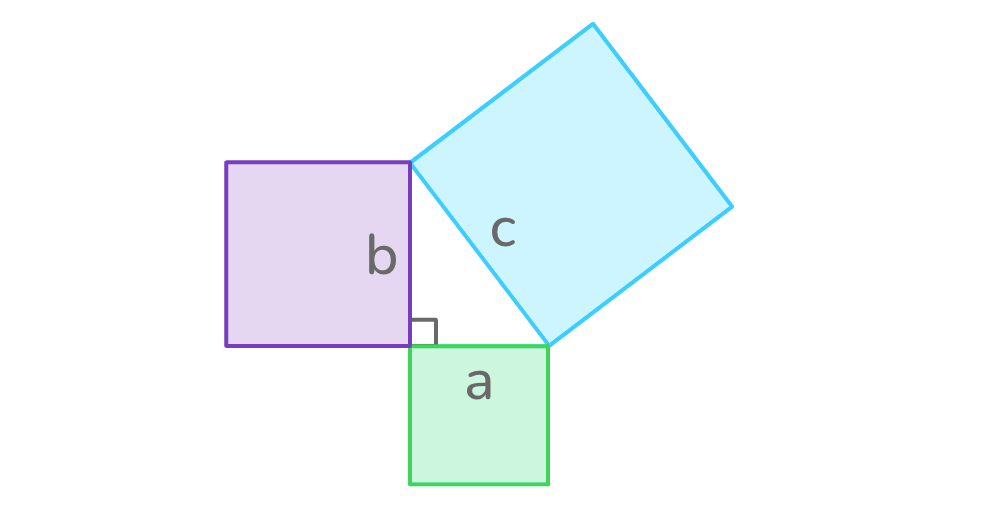
The Pythagorean Theorem is a formula used in geometry to relate the lengths of the sides of a right-angled triangle.
A right-angled triangle is a triangle that has one angle exactly equal to 90 degrees. The side opposite this right angle is called the hypotenuse, and it’s the longest side of the triangle.
The theorem states:
In a right-angled triangle, the square of the length of the hypotenuse is equal to the sum of the squares of the lengths of the other two sides.
It’s written as:
a2+b2=c2a^2 + b^2 = c^2a2+b2=c2
Where:
- a and b are the lengths of the two legs (the sides forming the right angle)
- c is the length of the hypotenuse
This simple equation helps solve countless geometry problems.
A Little History: Who Was Pythagoras?
The theorem is named after Pythagoras, a Greek mathematician and philosopher who lived around 570–495 BCE. Though there’s evidence that the Babylonians and Indians may have known about this relationship even earlier, Pythagoras was the first to prove it logically — and so it bears his name.
He and his followers, known as the Pythagoreans, believed that numbers were the essence of all things, and they treated math almost like a religion. Pretty cool, right?
Why Does It Work? (Understanding the Proof)
There are over 370 known proofs of the Pythagorean Theorem — some algebraic, some geometric. Let’s look at a simple visual proof.
Visual Proof: Rearrangement Method
Imagine a square with side length a+ba + ba+b. Inside it, place four identical right-angled triangles with sides a, b, and c.
You’ll notice that the remaining space in the center forms a smaller square with side length c (the hypotenuse).
- The large square’s area = (a+b)2(a + b)^2(a+b)2
- The area taken up by the 4 triangles = 4×12ab=2ab4 \times \frac{1}{2}ab = 2ab4×21ab=2ab
- The remaining area = the small square = c2c^2c2
So,
(a+b)2−2ab=c2(a + b)^2 – 2ab = c^2(a+b)2−2ab=c2
Expanding (a+b)2(a + b)^2(a+b)2, we get:
a2+2ab+b2−2ab=c2a^2 + 2ab + b^2 – 2ab = c^2a2+2ab+b2−2ab=c2 a2+b2=c2a^2 + b^2 = c^2a2+b2=c2
Voila! That’s the Pythagorean Theorem.
How Do You Use the Pythagorean Theorem?
Let’s see how to apply the theorem with some examples.
Example 1: Find the Hypotenuse
Suppose you have a triangle with:
- One leg = 3 units
- Another leg = 4 units
- Find the hypotenuse (c)
Using the formula:
a2+b2=c232+42=c29+16=c225=c2c=25=5a^2 + b^2 = c^2 \\ 3^2 + 4^2 = c^2 \\ 9 + 16 = c^2 \\ 25 = c^2 \\ c = \sqrt{25} = 5a2+b2=c232+42=c29+16=c225=c2c=25=5
So, the hypotenuse is 5 units long.
Example 2: Find a Missing Leg
Suppose:
- Hypotenuse = 13 units
- One leg = 5 units
- Find the other leg (b)
a2+b2=c252+b2=13225+b2=169b2=144b=144=12a^2 + b^2 = c^2 \\ 5^2 + b^2 = 13^2 \\ 25 + b^2 = 169 \\ b^2 = 144 \\ b = \sqrt{144} = 12a2+b2=c252+b2=13225+b2=169b2=144b=144=12
The missing leg is 12 units long.
Real-World Applications
The Pythagorean Theorem isn’t just for geometry class — it shows up in real life too!
- Construction and Architecture
Want to make sure a wall is straight and forms a right angle with the floor? Builders use the “3-4-5 rule” (a Pythagorean triple) to make sure corners are exactly 90°.
- Navigation and Mapping
GPS systems use the Pythagorean Theorem to calculate the shortest path between two points — especially when moving along a grid (like city blocks).
- Computer Graphics
Designers and game developers use it to measure distances between objects on a screen.
- Engineering
Engineers use it in structural analysis, bridge design, and even robotics — where precise measurements are crucial.
- Aviation
Pilots and air traffic controllers use the theorem to calculate flight paths and altitude changes.
Pythagorean Triples
Some right-angled triangles have sides that are whole numbers. These are called Pythagorean Triples.
Famous examples:
- (3, 4, 5)
- (5, 12, 13)
- (7, 24, 25)
- (8, 15, 17)
These are helpful for quick mental math or constructing right angles without a calculator.
Common Mistakes to Avoid
- Using it on non-right triangles
The theorem only works on right-angled triangles. If there’s no 90° angle, don’t use it! - Misidentifying the hypotenuse
The hypotenuse is always opposite the right angle and is the longest side. - Forgetting to take the square root
When solving for a side, don’t forget to take the square root at the end. - Wrong order of substitution
Label your sides carefully (a, b, c) before plugging into the formula.
Practice Time!
Problem 1:
A ladder is leaning against a wall. The base of the ladder is 6 feet from the wall, and the ladder reaches up 8 feet. How long is the ladder?
a=6,b=8,c=?62+82=c236+64=c2100=c2c=100=10a = 6, b = 8, c = ? \\ 6^2 + 8^2 = c^2 \\ 36 + 64 = c^2 \\ 100 = c^2 \\ c = \sqrt{100} = 10a=6,b=8,c=?62+82=c236+64=c2100=c2c=100=10
Answer: The ladder is 10 feet long.
Problem 2:
Find the missing leg:
- Hypotenuse = 17
- One leg = 8
82+b2=17264+b2=289b2=225b=158^2 + b^2 = 17^2 \\ 64 + b^2 = 289 \\ b^2 = 225 \\ b = 1582+b2=17264+b2=289b2=225b=15
Answer: The missing leg is 15.
The Pythagorean Theorem in Algebra and Beyond
The theorem forms the foundation for many other topics:
- Distance formula in coordinate geometry:
Distance=(x2−x1)2+(y2−y1)2\text{Distance} = \sqrt{(x_2 – x_1)^2 + (y_2 – y_1)^2}Distance=(x2−x1)2+(y2−y1)2
This is just a version of the Pythagorean Theorem in disguise!
- Trigonometry builds on the idea of right triangles with sine, cosine, and tangent.
- 3D Geometry: In three dimensions, the distance formula expands to:
x2+y2+z2\sqrt{x^2 + y^2 + z^2}x2+y2+z2
Summary: Why It Matters
Let’s wrap it up.
✅ The Pythagorean Theorem is a powerful tool in geometry.
✅ It only works for right-angled triangles.
✅ The formula is:
a2+b2=c2a^2 + b^2 = c^2a2+b2=c2
✅ It’s used in construction, navigation, tech, and more.
✅ It lays the groundwork for advanced math topics.
Whether you’re a student, an engineer, or someone who just enjoys a good puzzle, understanding the Pythagorean Theorem gives you an edge.
And remember — math isn’t just about numbers. It’s about solving problems, spotting patterns, and thinking logically. That’s what Study Rhino is here for — helping you learn smarter, not harder.
Bonus Tip from Study Rhino
Want to remember the Pythagorean Theorem easily?
Think of it as the math version of a triangle’s superhero rule:
Two small sides team up to equal the power of the hypotenuse!
Got a triangle? Pythagoras has your back.
Stay curious. Stay sharp. Study with the Rhino. 🦏