
World War I (WWI), also known as the Great War, was one of the most pivotal conflicts in human history, fundamentally altering the political, social, and economic landscape of the 20th century. Spanning from 1914 to 1918, this global war involved many of the world’s great powers, including the Allies, consisting mainly of France, the United Kingdom, Russia, and later the United States, and the Central Powers, primarily Germany, Austria-Hungary, the Ottoman Empire, and Bulgaria. In total, the war led to the deaths of millions of soldiers and civilians and created deep social and economic disruptions worldwide.
This article delves into the key events and outcomes of World War I, analyzing its causes, major battles, political repercussions, and its long-term impact on global history.
Causes of World War I
The causes of World War I are complex and intertwined. Historians often point to several long-term factors that created the conditions for a major conflict, as well as the immediate events that set the war into motion.
- Militarism: In the years leading up to the war, European nations engaged in a significant arms race. Military technologies were advancing rapidly, and countries like Germany, Britain, and France increased their military spending, which escalated tensions between them. The belief that conflicts could be resolved by military force led to an environment ripe for war.
- Alliances: Europe was divided into two main alliance systems— the Triple Alliance (Germany, Austria-Hungary, and Italy) and the Triple Entente (France, Russia, and the United Kingdom). These alliances were intended to maintain the balance of power, but they also meant that a conflict between two nations could quickly escalate into a broader war.
- Imperialism: European powers were in fierce competition for colonies in Africa and Asia. This imperial rivalry exacerbated tensions, particularly between Germany and other powers like Britain and France.
- Nationalism: Nationalist sentiment was rising across Europe, especially in the Balkans, where Slavic groups sought independence from the Austro-Hungarian Empire. This created a volatile political situation that contributed to the war.
- The Assassination of Archduke Franz Ferdinand: The immediate cause of World War I was the assassination of Archduke Franz Ferdinand, the heir to the Austro-Hungarian throne, in Sarajevo on June 28, 1914. The assassin, Gavrilo Princip, was a member of a Serbian nationalist group, and Austria-Hungary, with the backing of Germany, blamed Serbia for the attack. This event set off a chain reaction, with Austria-Hungary declaring war on Serbia, which led to the activation of alliances and the subsequent involvement of other nations.
Key Events of World War I
1. The Early Stages of the War: 1914
The war began with a rapid series of military movements and declarations. Austria-Hungary’s declaration of war on Serbia led to Russia mobilizing in defense of Serbia. Germany, allied with Austria-Hungary, declared war on Russia on August 1, 1914. Germany then declared war on Russia’s ally, France, on August 3. In response, the United Kingdom declared war on Germany on August 4 after Germany invaded Belgium.
The war initially saw rapid advances by both sides. German forces executed the Schlieffen Plan, which aimed to defeat France quickly by advancing through Belgium and then turning to fight Russia. However, the Belgian resistance and the unexpected strength of French forces led to a protracted war.
2. The Western Front: Trench Warfare
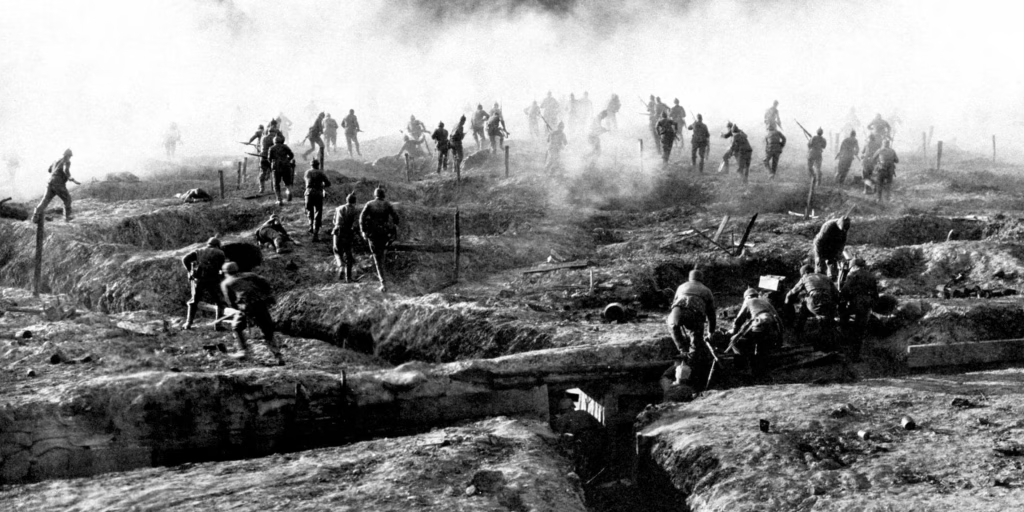
One of the most iconic features of World War I was the trench warfare that defined the Western Front. The battle lines between the Allies and the Central Powers, particularly in Belgium and France, became largely static by late 1914. Soldiers dug long, narrow trenches to protect themselves from machine-gun fire and artillery bombardments. The conditions were appalling—mud, disease, and the constant threat of death from enemy fire made life in the trenches unbearable.
The Battle of the Somme (1916) and the Battle of Verdun (1916) were two of the most brutal and infamous engagements on the Western Front. These battles saw staggering casualties, with no decisive victory for either side. The scale of the slaughter and the horrors of trench warfare became a symbol of the futility and destruction of World War I.
3. The Eastern Front
While the Western Front was marked by trench warfare, the Eastern Front, where German and Austrian forces faced off against Russian troops, was much more fluid. Initially, Russia had some successes, but by 1915, Germany and Austria-Hungary launched successful offensives, pushing Russian forces back. The Russian army, hampered by poor leadership, lack of supplies, and low morale, was increasingly unable to hold its ground.
The Eastern Front was also a major site of political upheaval. The Russian Revolution of 1917 led to the abdication of Tsar Nicholas II and the eventual withdrawal of Russia from the war, with the signing of the Treaty of Brest-Litovsk in March 1918 between Soviet Russia and the Central Powers.
4. The Entry of the United States: 1917
The United States initially maintained a policy of neutrality, but several factors led to its eventual entry into the war in 1917. The most significant of these was Germany’s policy of unrestricted submarine warfare. German U-boats sank several ships, including those with American passengers, such as the British ocean liner Lusitania in 1915. Additionally, the interception of the Zimmermann Telegram, in which Germany promised Mexico territory in the United States if it joined the war against America, further inflamed American public opinion.
President Woodrow Wilson, advocating for a “peace without victory,” asked Congress to declare war on Germany on April 6, 1917. The entry of the United States tipped the balance of power in favor of the Allies, who were struggling against the exhausted Central Powers.
5. The Collapse of the Central Powers
By 1918, the Central Powers were facing increasing difficulties. The entry of fresh American troops and supplies, combined with internal unrest and economic collapse, weakened their position. In Germany, there were growing protests and strikes, and the army was exhausted from years of fighting.
The Allies launched a series of offensives in the summer and fall of 1918, and by November, Germany had been pushed back to the brink of defeat. On November 11, 1918, Germany signed an armistice agreement, effectively ending the fighting.
Outcomes of World War I
1. Human and Economic Costs
World War I caused an immense loss of life and suffering. An estimated 10 million military deaths and 7 million civilian deaths occurred during the war. The psychological and physical scars on soldiers were profound, and many returned home with what we now recognize as post-traumatic stress disorder (PTSD).
The economic cost of the war was staggering. Europe’s infrastructure had been devastated, and many nations faced significant debt. The war led to severe inflation in some countries and economic instability in others.
2. Political Changes
World War I led to the downfall of several empires. The Austro-Hungarian Empire, the Ottoman Empire, the German Empire, and the Russian Empire all collapsed in the wake of the war.
- The Russian Revolution: The war exacerbated internal discontent in Russia, leading to the Bolshevik Revolution in 1917. The overthrow of the Tsarist regime led to the establishment of a communist government under Vladimir Lenin and the creation of the Soviet Union in 1922.
- The Treaty of Versailles: The peace treaty that ended the war was signed in 1919 and had profound political consequences. Germany was blamed for the war and subjected to harsh reparations and territorial losses. The Austro-Hungarian and Ottoman Empires were dismantled, and new nations were created in their place, such as Czechoslovakia and Yugoslavia.
- The League of Nations: Established by the Treaty of Versailles, the League of Nations was intended to promote international cooperation and prevent future conflicts. However, it failed to prevent the rise of militarism and the outbreak of World War II.
3. The Rise of Fascism and Communism
The economic instability and political upheaval caused by World War I contributed to the rise of extremist ideologies in several countries. In Italy, Benito Mussolini’s fascist regime took power in 1922, while in Germany, Adolf Hitler’s Nazi Party rose to prominence in the 1930s, partly as a reaction to the harsh conditions imposed on Germany by the Treaty of Versailles. In Russia, the Bolsheviks’ success led to the establishment of a communist government that would later be known as the Soviet Union.
4. The Road to World War II
The unresolved issues from World War I, combined with the harsh terms of the Treaty of Versailles, set the stage for World War II. The Treaty’s failure to achieve lasting peace and the deep resentment it caused, particularly in Germany, helped lay the groundwork for Adolf Hitler’s rise to power and the outbreak of World War II in 1939.
Conclusion
World War I was a catastrophic conflict that changed the course of history. The key events of the war, from the assassination of Archduke Franz Ferdinand to the signing of the Treaty of Versailles, had far-reaching consequences for global politics and society. The war not only caused immense loss of life and suffering but also reshaped the world’s political and economic structures, contributing to the rise of new ideologies and ultimately leading to World War II. Understanding the key events and outcomes of World War I is essential for grasping the complexities of modern history and the factors that continue to influence global affairs today.