
In a world saturated with information, opinions, and endless choices, the ability to think clearly and critically is more valuable than ever. Critical thinking — the process of carefully analyzing, evaluating, and synthesizing information — is not just a skill reserved for philosophers or scientists. It is essential for everyone, from students making academic decisions to adults navigating everyday life. At Study Rhino, we believe fostering critical thinking is a cornerstone of personal and academic success. Let’s dive deep into why critical thinking matters and how it shapes our world.
What is Critical Thinking?
Critical thinking involves a combination of skills: reasoning, analyzing arguments, identifying biases, solving problems, and making decisions based on evidence rather than emotion or assumption. It requires an open mind, intellectual curiosity, and a willingness to question even one’s own beliefs.
Rather than simply accepting information at face value, a critical thinker asks:
- What is the source of this information?
- Is there evidence to support it?
- Are there alternative perspectives?
- What assumptions are being made?
In essence, critical thinking empowers individuals to move beyond memorization and surface-level understanding towards deeper comprehension and thoughtful evaluation.
Why is Critical Thinking Important?
- Informed Decision-Making
From choosing a career path to selecting the right news sources, life is full of decisions. Critical thinking enables individuals to weigh options carefully, evaluate evidence, and make choices that are logical and beneficial. Without it, decisions may be impulsive, biased, or poorly informed.
- Protection Against Misinformation
The digital age has made information more accessible — and misinformation more rampant. Critical thinkers can spot inconsistencies, question questionable sources, and resist falling for “fake news,” conspiracy theories, and misleading advertisements. This not only protects personal integrity but also promotes a healthier, more informed society.
- Academic Excellence
Critical thinking is at the heart of true learning. Students who think critically are better at understanding complex ideas, writing analytical essays, solving problems creatively, and engaging in meaningful discussions. They do not just memorize facts for tests; they connect ideas, critique arguments, and innovate.
At Study Rhino, we encourage students to ask “why” and “how,” not just “what.” This transforms education from passive reception to active exploration.
- Career Success
Employers increasingly prioritize critical thinking skills. In virtually every field — business, healthcare, law, education, technology — professionals are expected to solve problems, innovate, and make sound judgments. Critical thinkers adapt to new challenges, work well in teams, and contribute thoughtful insights, making them invaluable assets to any organization.
- Personal Growth
Critical thinking promotes self-reflection and emotional intelligence. It encourages individuals to examine their own beliefs, question their assumptions, and become more open to new perspectives. This intellectual humility leads to greater personal growth, empathy, and resilience.
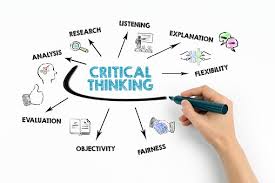
Key Components of Critical Thinking
Understanding critical thinking more deeply requires breaking it into key components:
- a) Analysis
This is the ability to break down complex information into parts, examine them, and understand relationships. For instance, analyzing a news article involves identifying the main argument, the supporting evidence, and any potential biases.
- b) Evaluation
Evaluating means judging the credibility and relevance of information. Is the source reliable? Is the argument logically sound? Does the evidence truly support the claims?
- c) Inference
Critical thinkers draw reasonable conclusions based on evidence. They go beyond the obvious to interpret underlying meanings or predict future outcomes.
- d) Explanation
It is not enough to have a conclusion; critical thinkers must also be able to explain their reasoning clearly and logically to others.
- e) Self-Regulation
Perhaps the most challenging component, self-regulation involves reflecting on one’s own thinking process, recognizing mistakes, and being willing to revise beliefs in light of new evidence.
Barriers to Critical Thinking
Despite its importance, critical thinking does not always come easily. Some common barriers include:
- Cognitive biases: Everyone has mental shortcuts that can cloud judgment (e.g., confirmation bias, where we seek information that supports our existing views).
- Emotional reasoning: Letting feelings dictate conclusions rather than objective evidence.
- Over-reliance on authority: Blindly accepting information from perceived experts without independent evaluation.
- Groupthink: Prioritizing harmony over critical evaluation in group settings.
- Lack of knowledge: Without adequate background knowledge, it becomes harder to critically evaluate new information.
Recognizing these barriers is the first step towards overcoming them.
How to Develop Critical Thinking Skills
The good news is that critical thinking is not an innate talent — it can be learned and strengthened with practice. Here are some practical ways to cultivate it:
- Ask Questions
The habit of questioning is the foundation of critical thinking. Train yourself to constantly ask:
- What is the evidence?
- Are there alternative explanations?
- What assumptions are being made?
- Who benefits from this information?
At Study Rhino, we often use Socratic questioning techniques to spark deeper inquiry.
- Read Widely and Thoughtfully
Expose yourself to diverse perspectives. Read not only materials that align with your beliefs but also those that challenge them. Engage critically with texts: highlight arguments, note evidence, and consider counterarguments.
- Engage in Discussions
Debate and dialogue sharpen critical thinking. Discuss topics with peers, teachers, or mentors. Be open to different viewpoints and practice defending your ideas logically and respectfully.
- Reflect on Your Thinking
After making decisions or forming opinions, pause to reflect:
- What evidence did I use?
- Was my reasoning sound?
- Could I have missed anything?
Journaling can be a powerful tool for self-reflection.
- Practice Problem-Solving
Engage in activities that require complex problem-solving — from solving puzzles and case studies to playing strategic games like chess. These activities build analytical and strategic thinking skills.
Critical Thinking in Education: A Study Rhino Approach
At Study Rhino, we believe that fostering critical thinking should not be an afterthought — it should be embedded in every aspect of education. Here’s how we promote it:
- Inquiry-based learning: Students explore questions and problems rather than passively receiving information.
- Project-based learning: Tackling real-world challenges encourages creativity, research, and critical evaluation.
- Debates and discussions: We organize structured debates to help students articulate and defend their viewpoints.
- Writing assignments: Analytical essays, research projects, and reflective writing promote deeper engagement with ideas.
- Feedback and reflection: Regular feedback sessions encourage students to think about how they think and how they can improve.
We also emphasize the ethical side of critical thinking — teaching students not only how to think but how to think responsibly, with empathy, integrity, and respect for others.
Conclusion: Critical Thinking is Empowerment
Critical thinking is more than an academic skill; it is a way of life. It equips individuals to navigate a complex world with clarity, integrity, and confidence. It fosters curiosity, innovation, empathy, and wisdom.
In a society where information is abundant but wisdom is scarce, critical thinkers stand out. They are not easily manipulated. They do not fall prey to superficial arguments. They ask better questions, find better answers, and contribute meaningfully to their communities.
At Study Rhino, we are passionate about nurturing the critical thinkers of tomorrow. We believe that by teaching students how to think — not just what to think — we empower them to shape a better, smarter, and more compassionate world.
So, let’s commit to the journey of thinking deeper, questioning smarter, and striving for truth. After all, in the words of Socrates, “The unexamined life is not worth living.”