
By Study Rhino
In our increasingly interconnected and globalized world, the ability to speak more than one language has become more than just a personal asset—it’s a global necessity. Whether you’re a student, a professional, or a parent, bilingualism offers cognitive, social, academic, and professional advantages that can positively influence every stage of life.
In this article, we’ll explore the many benefits of bilingualism, the science behind how it works, and why learning another language is one of the best investments in personal development and global citizenship.
What is Bilingualism?
Bilingualism refers to the ability to use two languages fluently. Some individuals learn both languages from birth (simultaneous bilingualism), while others learn a second language later in life (sequential bilingualism). Regardless of how or when it’s acquired, bilingualism is a valuable skill that shapes the brain, enhances communication, and bridges cultures.
There are varying degrees of bilingualism. Some people speak both languages with native fluency, while others may have a dominant and a secondary language. The key is functional proficiency—the ability to understand, speak, read, or write in both languages well enough to communicate effectively.
Cognitive Benefits of Bilingualism
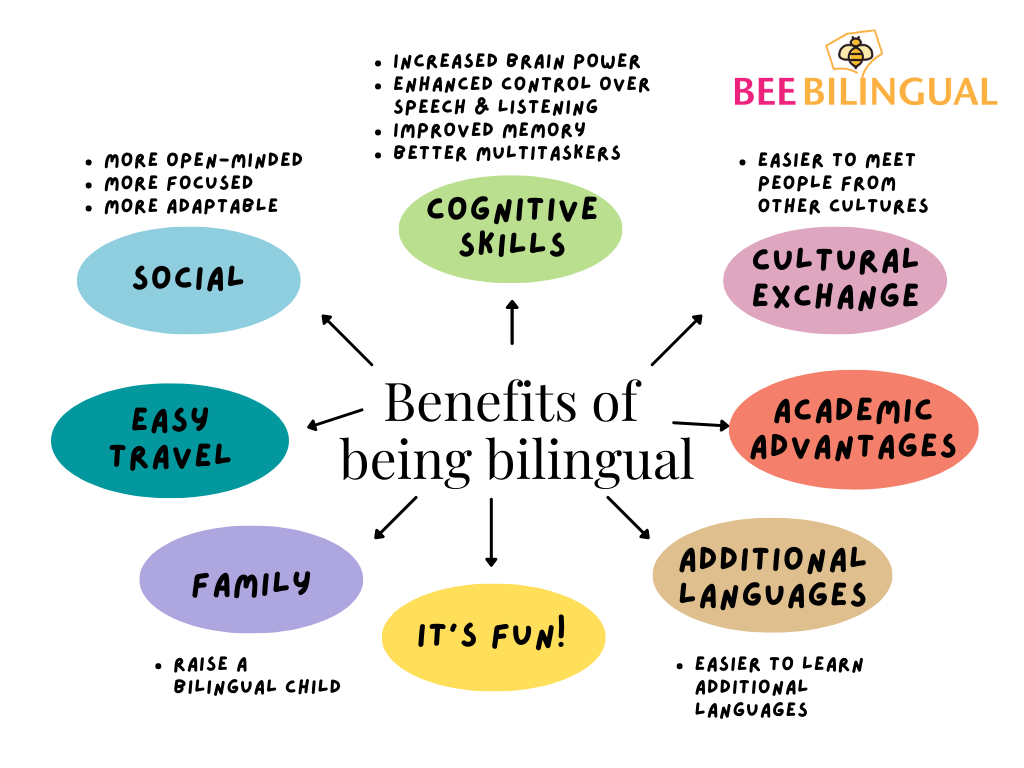
One of the most well-documented areas of research in bilingualism is its cognitive impact. Scientists have found that bilingual individuals enjoy a number of mental benefits:
1. Enhanced Brain Function
Bilinguals frequently switch between two language systems, which strengthens the brain’s executive functions. These functions include problem-solving, multitasking, and focusing attention. Studies show that bilingual individuals are better at ignoring irrelevant information and shifting attention between tasks.
2. Improved Memory and Mental Flexibility
Learning and managing two languages require memory and cognitive flexibility. Bilinguals often perform better in memory tasks and exhibit stronger mental adaptability—an important skill in both academic and everyday settings.
3. Delayed Onset of Dementia
Several studies have suggested that bilingualism can delay the onset of dementia and Alzheimer’s disease by up to 4–5 years, compared to monolinguals. Constantly exercising the brain through language management appears to build cognitive reserve that protects against age-related decline.
Academic Advantages
Bilingual students often outperform their monolingual peers in certain academic areas, especially in reading, problem-solving, and standardized testing.
1. Better Literacy Skills
Learning two languages helps children understand how language works, making them more sensitive to grammar, structure, and vocabulary. This can translate into stronger reading and writing skills in both their languages, as well as in learning a third one.
2. Enhanced Academic Achievement
Research indicates that bilingual students are more likely to perform better academically, especially in subjects that require abstract thinking, such as mathematics and science.
3. Easier Learning of Additional Languages
Once someone becomes bilingual, it becomes significantly easier to learn a third or fourth language, because they have already developed the cognitive framework to learn and manage multiple linguistic systems.
Social and Cultural Benefits
Language is deeply tied to identity, culture, and community. Bilingualism provides the ability to interact with more people, appreciate different cultures, and develop empathy.
1. Bridging Cultural Gaps
Bilingual individuals can act as cultural bridges, helping others understand and appreciate different traditions, beliefs, and customs. This can lead to more inclusive and respectful communities.
2. Increased Empathy and Social Skills
Navigating multiple linguistic and cultural systems improves perspective-taking—the ability to see things from another’s point of view. Bilinguals often show higher levels of empathy and emotional intelligence.
3. Stronger Family and Community Ties
For children from multilingual households, maintaining their heritage language strengthens family bonds and helps them stay connected to their cultural roots. It also allows them to participate more fully in their communities and heritage traditions.
Economic and Career Advantages
In today’s global economy, bilingualism can be a career-defining skill. Many industries are looking for professionals who can communicate with clients, partners, and colleagues across different language backgrounds.
1. Better Job Opportunities
Bilinguals are in high demand in fields such as education, healthcare, international business, law, translation, tourism, and diplomacy. Knowing more than one language often gives candidates a competitive edge.
2. Higher Salaries
Studies have found that bilingual employees can earn up to 5–20% more than their monolingual peers. Language proficiency can be a valuable asset in salary negotiations and promotions.
3. Greater Mobility and Flexibility
Bilingual professionals can work and live in a variety of countries, making them ideal candidates for international assignments, remote jobs, and global companies.
Bilingualism in Education
Given its many benefits, educational systems around the world are increasingly incorporating bilingual and dual-language programs into their curricula.
1. Dual-Language Immersion Programs
These programs teach students in two languages, often beginning in kindergarten. The goal is for students to become fully literate and academically proficient in both languages. These programs have been successful in improving academic outcomes across diverse student populations.
2. Early Language Exposure
Research shows that the earlier a child is exposed to a second language, the better their pronunciation and fluency will be. Children are also more naturally receptive to language learning in the early years.
3. Parental Support and Community Engagement
Parents can support bilingualism at home by reading, speaking, and encouraging language use in both languages. Community centers, language schools, and cultural programs also play a key role in fostering bilingualism.
Challenges and Misconceptions
While the benefits of bilingualism are clear, there are still some common myths and challenges that need to be addressed.
1. Myth: Bilingualism Confuses Children
One of the most persistent myths is that learning two languages confuses young children or causes speech delays. In fact, bilingualism does not hinder language development—it simply looks different. Bilingual children may initially mix languages (code-switching), but this is a normal and temporary part of learning.
2. Balancing Proficiency
It’s common for bilinguals to have a dominant language and a weaker one. Regular practice and exposure are key to maintaining fluency in both. Parents and educators should support language use in a variety of contexts to build balanced proficiency.
3. Lack of Resources
In some areas, there may be limited access to quality bilingual programs or resources. However, online tools, apps, language exchange programs, and community support can help fill these gaps.
Real-World Examples
1. Canada
Canada is a global leader in bilingual education, with English and French as official languages. Many Canadian students graduate with high proficiency in both languages, opening up nationwide and international opportunities.
2. European Union
In the EU, multilingualism is encouraged from an early age. Most students learn at least two foreign languages, fostering cultural understanding and unity among member states.
3. India
India is one of the most linguistically diverse countries in the world, with students often fluent in their regional language, Hindi, and English. This multilingual environment has significant social and cognitive benefits.
Conclusion: A Future Built on Bilingualism
Bilingualism is not just a skill—it’s a superpower in the 21st century. It strengthens the brain, builds bridges across cultures, enhances academic and career prospects, and deepens one’s understanding of the world.
Whether you are a student considering learning a second language, a parent raising bilingual children, or an educator shaping future generations, embracing bilingualism opens doors that monolingualism simply cannot.
At Study Rhino, we believe that language learning is a key part of educational success and global citizenship. So go ahead—embrace the challenge, explore new cultures, and speak your way to a smarter, more connected future.