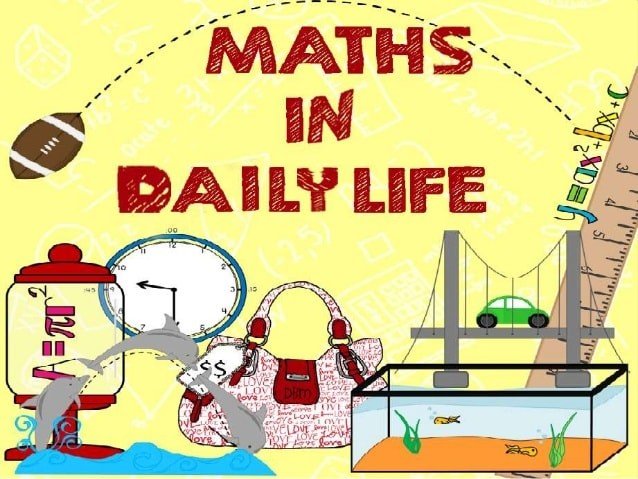

Mathematics is often viewed as a subject confined to the classroom, with many students questioning its relevance to their everyday lives. However, math plays a crucial role in various aspects of daily living, even if it isn’t always immediately visible. From budgeting and shopping to cooking and planning trips, the applications of math are endless and vital to understanding the world around us. In this article, we will explore the importance of math in daily life and why it is much more than a school subject—it is an essential tool for everyday decision-making.
1. Math and Personal Finance
One of the most common uses of math in daily life is personal finance. Managing money requires a solid understanding of math concepts like addition, subtraction, multiplication, and percentages. Whether you’re budgeting for groceries, saving for a vacation, or trying to pay off debt, math is key to making informed financial decisions.
For example, if you’re planning to buy a car, understanding the concept of interest rates and loan terms is essential. The total cost of a loan isn’t just the price of the car—it includes the interest accrued over the loan period. Without basic math skills, it would be difficult to calculate how much the loan will actually cost you in the long run.
Moreover, everyday purchases require basic calculations. Discounts, sales tax, and tips all require a quick understanding of percentages. If a shirt is priced at $50 with a 20% discount, how much will you pay after the discount? Such simple calculations ensure that we are not overpaying and help us make the best purchasing decisions.
2. Time Management and Scheduling
Managing time effectively is an essential skill in today’s fast-paced world. Whether you are a student juggling school assignments or a working professional balancing meetings and deadlines, math helps in scheduling and planning your day. The ability to calculate the amount of time you need to complete a task or how to break up your day into manageable blocks is a critical life skill.
Time management involves calculating hours and minutes, understanding schedules, and prioritizing tasks. For instance, if a project needs to be completed in two days, how do you divide your time effectively? If you know that the task will take four hours, you can break the time into chunks and allocate specific hours each day. Without the ability to make these calculations, it would be easy to miss deadlines or waste time.
Additionally, determining travel time and estimating when you will arrive at a destination also involves math. When planning a trip, you need to know the distance between locations and calculate the time required to reach your destination, including factoring in traffic, speed limits, and breaks. By using basic math, you can avoid unnecessary delays and ensure you’re on time.
3. Cooking and Baking
When cooking or baking, math becomes a vital tool for success. From measuring ingredients to adjusting recipes, math ensures that the final product turns out as intended. The ability to measure quantities correctly, convert units, and scale recipes up or down is directly tied to math skills.
For example, if a recipe calls for 2 cups of flour, but you want to make half the recipe, you’ll need to divide the amount in half—1 cup of flour. Similarly, if you’re cooking for a large group and need to double a recipe, you must multiply the ingredients by two. Math ensures that the proportions remain accurate, leading to better-tasting food and minimizing waste.
In baking, math is even more important as the correct ratios are essential for the desired texture and taste. Whether you’re making a cake, bread, or cookies, the balance between wet and dry ingredients requires mathematical precision.
4. Shopping and Budgeting
Math is essential when it comes to shopping and budgeting. We often encounter sales, discounts, or promotions that require us to calculate how much we’re actually saving or spending. For example, if an item is on sale for 25% off, understanding how much the discount saves you is an important math skill.
Furthermore, keeping track of your expenses involves creating a budget, which is essentially a mathematical calculation. You must understand how much money you have, how much you plan to spend, and how to divide your money across various categories like groceries, entertainment, and savings. By analyzing your income and expenses, you can ensure that you are living within your means.
Let’s say you’re shopping for groceries and notice that a 2-liter bottle of soda is priced at $2.50, while a 3-liter bottle is $3. How do you determine which is the better deal? By dividing the price by the volume, you can compare the price per liter and make an informed decision.
5. Travel and Navigation
Math plays a crucial role when it comes to travel and navigation. Whether you’re traveling by car, plane, or train, you need to use math to calculate distances, travel times, and routes. For instance, if you’re driving, you’ll need to know how many miles are between your current location and your destination, and how long the journey will take based on your speed.
Additionally, math is used to determine fuel efficiency. If your car gives you an average of 30 miles per gallon and you need to drive 150 miles, math can help you calculate how much fuel you will need. Without understanding math, you could risk running out of gas or not knowing how much money to set aside for fuel.
Planning a trip also involves budgeting for various expenses such as lodging, food, and activities. If you are traveling abroad, exchange rates come into play, and understanding how to convert currencies is a key skill. A small miscalculation could result in overspending or underestimating the costs of your trip.
6. Home Improvement and DIY Projects
Home improvement and DIY projects are another area where math is essential. Whether you are building a piece of furniture, painting a wall, or laying tiles, you will need to measure and calculate quantities.
For example, when painting a room, you must know the area of the walls in order to buy the correct amount of paint. If a can of paint covers 400 square feet and your room’s walls total 800 square feet, you will need two cans of paint. This calculation helps you avoid buying too much or too little paint, saving both time and money.
Similarly, if you are laying a floor or installing tiles, you need to calculate the number of tiles required to cover the space. The size of each tile and the total area to be covered must be factored in to determine the correct number of tiles, reducing waste and ensuring the project’s success.
7. Health and Fitness
Maintaining good health and fitness is another area where math is frequently used. Whether you are tracking your calorie intake, measuring your body’s mass index (BMI), or calculating how much weight you should lift, math plays a role in optimizing your fitness routine.
For example, if you want to lose weight, understanding the concept of caloric deficit is crucial. You need to burn more calories than you consume to shed pounds. Similarly, if you are following a workout plan, you may need to calculate the number of sets, repetitions, and the weight you should use to achieve your fitness goals.
Additionally, math helps in understanding various health metrics such as blood pressure, cholesterol levels, and heart rate. These metrics involve basic calculations, such as converting units (e.g., from milligrams to grams) and interpreting the data to assess overall health.
8. Problem-Solving and Logical Thinking
Math is not just about numbers; it is also about developing problem-solving and logical thinking skills. The ability to analyze a situation, break it down into smaller parts, and apply logical reasoning to find a solution is a skill that math helps develop. Whether you are solving a complex work problem or deciding the best route to take on a road trip, math teaches you how to approach challenges systematically.
Critical thinking, pattern recognition, and decision-making are all skills honed through mathematical learning. By approaching problems with a logical mindset, you can improve your ability to make informed decisions in all areas of life.
Conclusion
From personal finance and time management to cooking and problem-solving, math is deeply integrated into our daily lives. While many people may not immediately recognize its importance, math is an essential tool for navigating the modern world. It enables us to make informed decisions, optimize our resources, and improve our quality of life. The next time you encounter a seemingly trivial math problem—whether it’s comparing prices, calculating travel time, or budgeting—remember that these skills are vital to your success and well-being.