

by Study Rhino
Taking effective notes in class is more than just writing down what the teacher says. It’s a skill that, when mastered, can make learning faster, easier, and more enjoyable. Good notes help you stay focused during lectures, understand key concepts, and study efficiently for exams. Whether you’re in high school, college, or a skill-building workshop, knowing how to take smart notes can make a big difference in your academic journey.
In this comprehensive guide, we’ll explore practical techniques, strategies, and tips for becoming a master note-taker in any class setting.
Why Note-Taking Matters
Before diving into methods, let’s understand why note-taking is so important.
1. Improves Focus and Concentration
When you’re actively listening and writing, your brain is more engaged. You pay closer attention and stay alert, reducing the chances of zoning out.
2. Enhances Memory and Understanding
Writing things down in your own words helps reinforce learning. It also makes complex information easier to digest.
3. Creates a Personalized Study Tool
Good notes become your go-to resource for revision, especially before tests. They capture the essence of a lesson in a format you understand best.
Before Class: Set Yourself Up for Success
Preparation is key. You can’t take good notes if you’re not mentally or physically ready.
1. Do the Pre-Reading
If your teacher gives out reading material beforehand, go through it. This gives you a foundation and helps you identify key ideas when they’re discussed in class.
2. Organize Your Materials
Keep your notebooks, pens, highlighters, and digital devices ready. Choose a note-taking tool (notebook or app) you’re comfortable with.
3. Set a Goal for the Class
Think about what you want to learn from the session. This mental framework helps you stay focused and take notes with purpose.
During Class: Techniques for Effective Note-Taking
1. Be an Active Listener
Don’t try to write down everything. Instead, listen carefully and jot down the main points, supporting details, and examples.
2. Use Abbreviations and Symbols
Speed is essential in note-taking. Create your own shorthand to save time:
- “w/” for with
- “ex.” for example
- “↑” for increase, “↓” for decrease
- “→” for leads to
3. Highlight Key Terms and Concepts
Use underlines, stars, or highlighters to mark critical points. This will make reviewing much easier later.
4. Don’t Get Stuck on One Point
If you miss something, leave space and move on. You can ask a classmate or teacher to fill in the blanks afterward.
5. Capture Questions and Thoughts
If something confuses you, note it down with a question mark (?) beside it. This encourages follow-up and clarification.
Popular Note-Taking Methods
There’s no “one-size-fits-all” strategy. Try different methods and see what works best for you.
1. The Cornell Method
This is a structured and highly effective method. Divide your page into three sections:
- Cue Column (Left): Write down keywords or questions.
- Note-Taking Area (Right): Take notes during the class.
- Summary (Bottom): After class, write a brief summary of what you learned.
✅ Best for: Organizing ideas and reviewing later.
2. The Outline Method
Use bullet points and indentation to organize information in a hierarchical way:
- Main topic
- Subtopic
- Detail or example
- Subtopic
✅ Best for: Subjects with structured content (like History or Science).
3. The Mapping Method
This is a visual technique. Start with a central idea and branch out into related concepts.
✅ Best for: Visual learners and understanding relationships between ideas.
4. The Charting Method
Use columns to compare information (e.g., dates, events, definitions).
| Topic | Definition | Example | Importance |
| Photosynthesis | Process by which plants make food | Sunlight + CO2 → Glucose | Vital for food chains |
✅ Best for: Memorizing facts and comparisons.
5. The Sentence Method
Write every new thought, fact, or topic on a separate line, numbering them as you go.
✅ Best for: Fast-paced lectures or classes with no clear structure.
Digital vs. Handwritten Notes
Handwritten Notes
- Pros: Better memory retention, encourages summarization.
- Cons: Slower, hard to edit or organize.
Digital Notes (using apps like OneNote, Notion, Google Docs)
- Pros: Faster typing, easily searchable, multimedia options (audio, images, links).
- Cons: Higher chance of distraction, less memory retention compared to handwriting.
💡 Tip: Use a stylus on a tablet to combine the benefits of both methods.
After Class: Review and Revise
Note-taking doesn’t end when the bell rings. The real magic happens during review.
1. Rewrite or Clean Up Your Notes
Soon after class, go through your notes and rewrite or tidy them. This reinforces what you’ve learned and fills in any gaps.
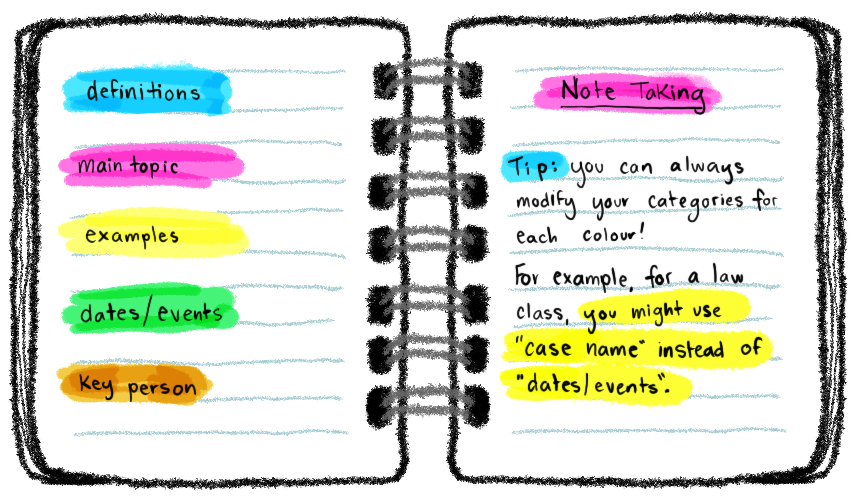
2. Highlight and Color Code
Use colors to emphasize different types of content:
- Yellow for definitions
- Green for examples
- Red for important concepts
3. Summarize in Your Own Words
Try to explain the topic to yourself or a friend without looking at your notes. This reveals how well you truly understand it.
4. Use Spaced Repetition
Review your notes multiple times over a few days or weeks. Spaced repetition improves long-term memory.
Bonus Tips to Level Up Your Note-Taking
1. Create a System That Works for You
Use symbols, colors, and styles that you’re comfortable with. Over time, this becomes second nature.
2. Stay Organized
Keep your notes sorted by subject and date. Use folders or digital tags to keep things neat.
3. Ask Questions
Don’t be afraid to clarify doubts with your teacher. Write down the answers in your notes.
4. Collaborate with Classmates
Share and compare notes. Sometimes, others catch things you missed.
5. Use Audio Recordings (if allowed)
If permitted, record the lecture and listen again later while refining your notes.
Common Mistakes to Avoid
- ❌ Trying to write down everything word for word
- ❌ Not reviewing or revising notes after class
- ❌ Using messy, unstructured formats
- ❌ Relying only on someone else’s notes
- ❌ Ignoring difficult concepts instead of asking questions
Conclusion
Taking effective notes in class is a skill that develops over time. With the right techniques, a bit of practice, and consistent review, you can turn every lecture into a powerful learning experience. Whether you’re a visual learner, a fast typist, or someone who prefers good old pen and paper, there’s a note-taking style that’s perfect for you.
At Study Rhino, we believe that smart study habits like note-taking pave the way for academic success. So the next time you’re in class, grab your notebook (or open your laptop), and remember: You’re not just writing — you’re learning, growing, and building your future.
📚 Study Smarter, Not Harder — with Study Rhino.
Follow us for more study tips, academic guides, and student resources! 🦏
Let me know if you’d like this adapted into a printable PDF, blog post format, or even paired with visual examples for students!